
Conducting Content Analysis with NVivo for PhD Research
Scholars conducting PhD research utilize Computer-Assisted Qualitative Data Analysis Software (CAQDAS) to analyze qualitative data. Compared to manual approaches, CAQDAS offer PhD scholars with effective functions such as quick drag and drop coding and creating audit trails, among others. There are various software programs scholars can employ in qualitative PhD research, including NVivo, MAXQDA, and Atlas. ti.
NVivo is a CAQDAS tool used in qualitative research that allows scholars to organize, code, and analyze data. NVivo’s ability to analyze large amounts of qualitative data enhances PhD research efficiency and supports the production of high-quality research outcomes. With NVivo, PhD scholars can conduct a variety of qualitative techniques such as content, thematic, narrative, discourse analysis, and grounded theory. This article entails a guide on conducting content analysis with NVivo, highlighting the step-by-step process scholars can follow to examine meanings, themes, and patterns that are latent in a particular text.

Understanding Content Analysis with NVivo
Content analysis with NVivo involves the subjective interpretation of the content of data through the systematic classification process of coding and identifying themes or patterns. Qualitative content analysis aims to examine meanings, themes, and patterns that manifest or are latent in a particular text. By analyzing the content of communication, PhD scholars gain a comprehensive understanding of the intentions and emotions embedded in text, which is important for developing theories and informing practice. NVivo enables efficient content analysis in graduate research by allowing students to:
- Organize multiple data sources in one central project. NVivo allows scholars to gather various forms of qualitative data, including transcripts and documents, into one workspace for a simplified analysis.
- Code qualitative data. NVivo has multiple functions that support efficient coding, including in vivo coding, coding stripes, autocoding, and memo creation. NVivo also has an autocoding feature powered by AI that automatically detects and codes themes or sentiments, allowing scholars to focus less on the process of coding and more on the content analysis.
- Query and search data. NVivo has a function called the text search query that allows PhD students to identify where particular words occur in the context of text data.
- Visualize data. NVivo enables scholars conducting graduate research to transform their analysis into compelling visuals to communicate findings and enable understanding of results.
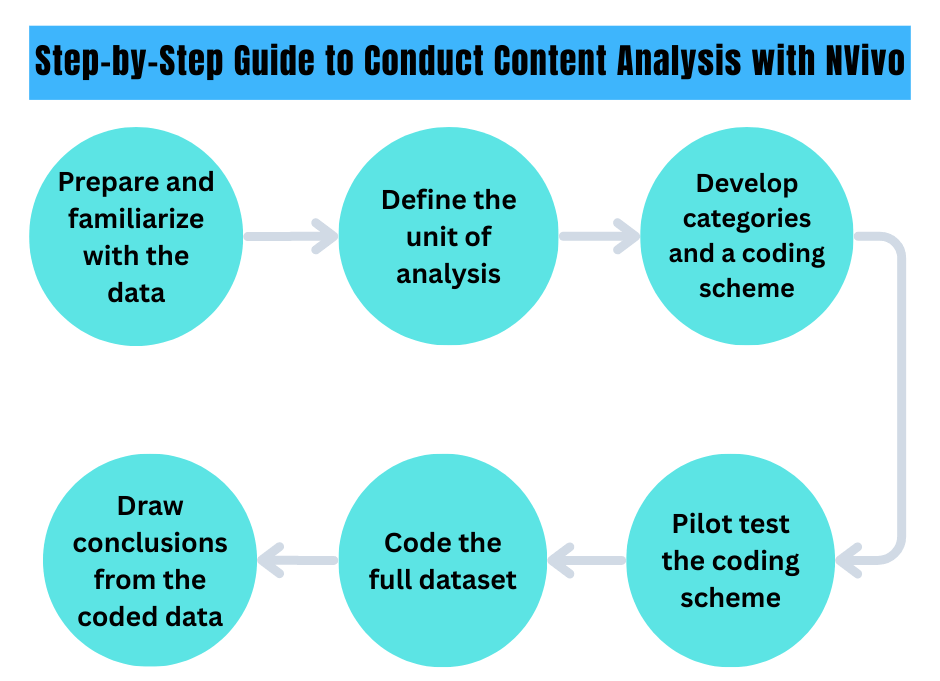
Step-by-Step Guide on How to Conduct Content Analysis with NVivo
This section contains an NVivo research guide on how to conduct content analysis.
Step 1: Prepare and Familiarize with the Data
Qualitative content analysis can be used to analyze various types of data, but the data should be transformed into written text first. To prepare data, first, scholars should perform tasks such as transcribing recordings, correcting errors, and anonymizing details to protect participants. Second, PhD students should export the cleaned files to a text-searchable format, then read through each file at least once without coding. To familiarize themselves with the data, scholars can utilize margin notes and memos to note reflective thoughts or possible analytic directions.
Step 2: Define the Unit of Analysis
The unit of analysis is the smallest piece of data that will receive a code. Qualitative analysis typically uses individual themes as the unit for analysis. An instance of a theme can be expressed as a single word, phrase, sentence, paragraph, or entire document. Scholars conducting PhD research should select the unit, state the choice in the method section, and keep it stable across the dataset so that counts and comparisons remain meaningful.
Step 3: Develop Categories and a Coding Scheme
Categories and a coding scheme can be acquired from three sources, which include data, previous related theories, and theories. Categories can be developed both inductively and deductively. In deductive studies, categories derive from theory or policy guidelines, while in inductive research, categories are acquired from open-coding.
A coding scheme is a systematic approach to assigning codes to qualitative data to facilitate analysis. To develop a coding scheme, first, PhD scholars should create nodes using the Create tab of the toolbar at the top. Second, students should double-click a node to see every fragment coded with that node in each file. Each document will be linked, followed by each fragment with the specific node.
Step 4: Pilot Test the Coding Scheme
The best test of clarity and consistency of the category definitions and coding scheme is to code a sample of data. To create codes in NVivo, first, in the Navigation Panel, scholars should click the arrow beside coding to expand the folder and select codes. Second, PhD students should right-click the white space in the List View and select New Code.
Third, scholars should give the code a name and a description of when that code should be applied. Fourth, scholars should assign the code a color, then click OK, and the code will appear in the Codes List Window. After the sample is coded, scholars should identify disagreements, vague definitions, and missing categories to ensure consistency.
Step 5: Code the Full Dataset
Coding involves the integration of textual data into segments, examining the data similarities and differences, and grouping conceptually similar data in the respective nodes. Coding in NVivo is conducted in the document browser. To code a segment of text in a project document under a specific node, researchers should first highlight the relevant portion of the text. After selecting the text, they can drag the highlighted section to the appropriate node in the coding window. This action assigns the selected text to that node, allowing the researcher to organize and categorize data systematically within the project.
The segments that have been coded to a particular node are highlighted in colors, and nodes that have been attached to a document turn bold. Scholars can also activate coding stripes to view the quotes that are associated with the particular nodes. With the guide of highlighted text and coding stripes, scholars can return to their data to conduct further coding or refine the coding.
Step 6: Draw Conclusions From the Coded Data
Drawing conclusions from the coded data involves understanding the themes or categories identified and their properties. Scholars conducting PhD research make inferences and present their reconstructions of meanings derived from the data. Activities scholars employ to draw conclusions may include exploring the properties and dimensions of categories, identifying relationships between categories, and uncovering patterns. Whether you are a scholar applying qualitative analysis methods such as thematic analysis and content analysis, exploring thematic coding, or reporting results, NVivo supports a wide range of techniques for PhD research that enable scholars to analyze and interpret their results with confidence.
Best Practices for Conducting Content Analysis with NVivo
To ensure the reliability and trustworthiness of results after conducting content analysis with NVivo, students conducting PhD research can employ practices such as:
- Creating an organized coding frame. A clear coding scheme guides scholars conducting PhD research through their data to identify useful patterns and themes that can address their research questions. Developing a well-structured coding frame increases the validity and reliability of qualitative data.
- other researchers. NVivo has a collaboration cloud that enables users to connect to the same project, code and analyze research in real time.
- Ensuring clear documentation. Only when other investigators have observed and verified how the PhD study was conducted is the research trustworthy. The transparency checklist scholars should evaluate when conducting content analysis with NVivo comprises i). coding scheme with node descriptions, ii). coding and memoing guidelines, iii). analytic plan, iv). analytic memos, and v). node reports.
- Utilizing various queries and visualizations. NVivo has multiple queries and visualizations that allow PhD scholars to explore their data for patterns and investigate hunches as they progress through their project.
Summary
Content analysis is a useful technique commonly used by scholars conducting PhD research. The aim of conducting a content analysis is to identify important themes within a body of text and offer a description of the social reality created by those categories as they are lived out in a particular setting. Through data preparation, coding, and interpretation using software such as NVivo, the results of content analysis can support the development of new theories and models in PhD research. As scholars develop their research design, they should consider applying content analysis with NVivo as an efficient way to identify themes and patterns that are latent in a particular text. Contact us for any inquiries on qualitative content analysis or talk to our customer service agents through our live chat.