
Big Data Analytics Tools Explained
Big data is arguably the most valuable asset a business can possess, given its significant role in enabling informed decision-making and improving performance. To leverage the data, businesses need to have robust approaches in place to handle the massive volumes of data. As such, using big data analytics tools is crucial for businesses to identify trends, point out patterns, and obtain valuable insights they can use to make informed business decisions. Leveraging advanced big data analytics tools with diverse processing capabilities allows businesses to gain a competitive edge in the market.
This article contains an explanation of the latest big data analytics tools, such as cloud data warehouses and analytics, and data processing and streaming. Also, we have discussed how to choose the best big data analytics tools and the most appropriate methods to use.
What are Big Data Analytics Tools?
Big data analytics is the process of examining multifaceted and large datasets to discover trends, hidden patterns, and correlations. Additionally, big data analytics entails processing massive datasets to derive meaningful insights and support decision-making. Through big data analytics, businesses can move from what happened in the past to what should be done next.
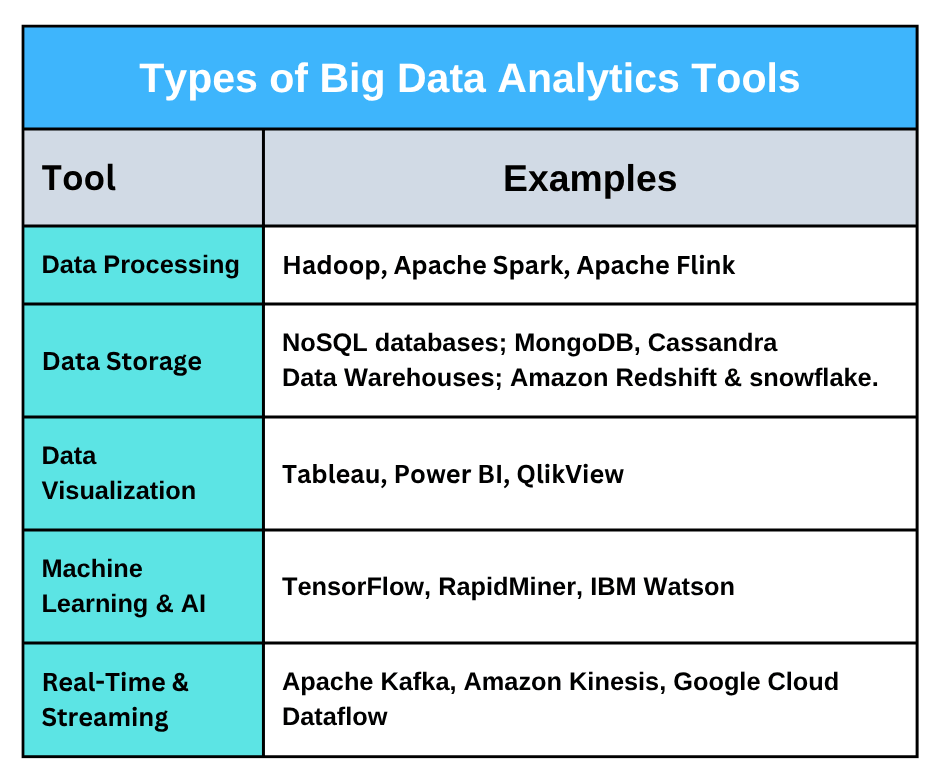
Which are the Latest Big Data Analytics Tools?
In today’s market, big data analytics enables organizations to derive measurable business value from large datasets. The latest tools for data analytics are;
1. Cloud Data Warehouses and Analytics
Cloud data warehouses are cost-effective, scalable, and fully managed solutions for storing large datasets, while analytics tools are used to examine and obtain accurate insights from raw data. Cloud data warehouses enable concurrent query procedures without the limitations of traditional and on-premise hardware. By utilizing pay-per-click models and separating compute from storage analytics platforms offer high-performance SQL processing for large and diverse data sources.
2. Data Processing and Streaming
Data processing and streaming enable real-time analysis through continuous capturing, cleaning, and analyzing high-velocity data. Unlike traditional batch processing, which gathers and examines data at static intervals, these tools operate with low latency to enable businesses to make informed decisions. The capability of data processing and streaming is critical in the current fast-paced digital era, where delays in data examination may result in security risks, missed opportunities, and operational inefficiencies.
3. Visualization and Business Intelligence
Visualization and business intelligence act as complementary tools for big data by converting vast and multifaceted datasets into accurate insights through visual and interactive representations. These tools integrate data sources, enabling data-driven decision-making, enhanced operational efficiency, and predictive analytics in businesses. In addition, visualization and business intelligence are essential for empowering companies to detect trends and patterns to convert unprocessed data into comprehensible and strategic insight.
4. Advanced Analytics, AI, and Data Management
Advanced data management is essential for automating detection, cleaning, and preparation processes, critical for handling a variety of big data. Advanced analytics techniques are used in predictive modeling, neural networks, and machine learning to identify trends and future outcomes for business productivity. Additionally, AI employs natural language processing for data querying and machine learning to recognize patterns and derive insights from unstructured data to improve business productivity.
How to Choose the Best Big Data Analytics Tools
Choosing the best analytics tools for big data requires an evaluation of specific business objectives, team technical skills, and data volume, while focusing on security, scalability, and integration capabilities. The process of choosing the tools entails;
1. Define Objectives and Use Cases
To define objectives and use cases for analytics tools for bulky data, start with business problems and not the technology. To successfully select analytical tools, it’s important to define objectives and use cases by setting specific, measurable, achievable, relevant, and time-bound goals. Additionally, choosing the best analytical tools for big data involves setting high-value data scenarios and certifying that the selected appliances align with the set requirements.
2. Evaluate Key Features
To evaluate the key features of the analytics tools, prioritize integration, scalability, data security, and ease of use to match the business objectives. Key steps in the evaluation of analytical tools for big data entail assessing their ability to handle growing data volumes and high processing speeds with limited performance degradation. Additionally, evaluating the analytics tools’ key features should involve checking for seamless connectivity with current systems and databases.
3. Assess Usability and Skill Set
Assessing usability and skill set requirements is important for successful big data tool adoption, ensuring that the platform enhances productivity rather than just creating bottlenecks. The best approach in assessing usability and skill set entails aligning tool complexity with team proficiency, using free hands-on evaluation trials, and considering both technical and general user needs. In addition, assessing usability and skill set determines how easily a team will adopt the tool.
4. Verify Security and Compliance
When choosing an analytics tool for bulky data, verifying safety and compliance requires a systematic evaluation of encryption standards to enhance security, regulatory alignment, and access control. The key steps involved in the verification include the assessment of data handling, a review of third-party audit reports, and a confirmation that the platform supports granular role-based access control (RBAC). Another step is to map the data types to determine the protection level required and ensure the tools used are compliant with the company-specific laws.
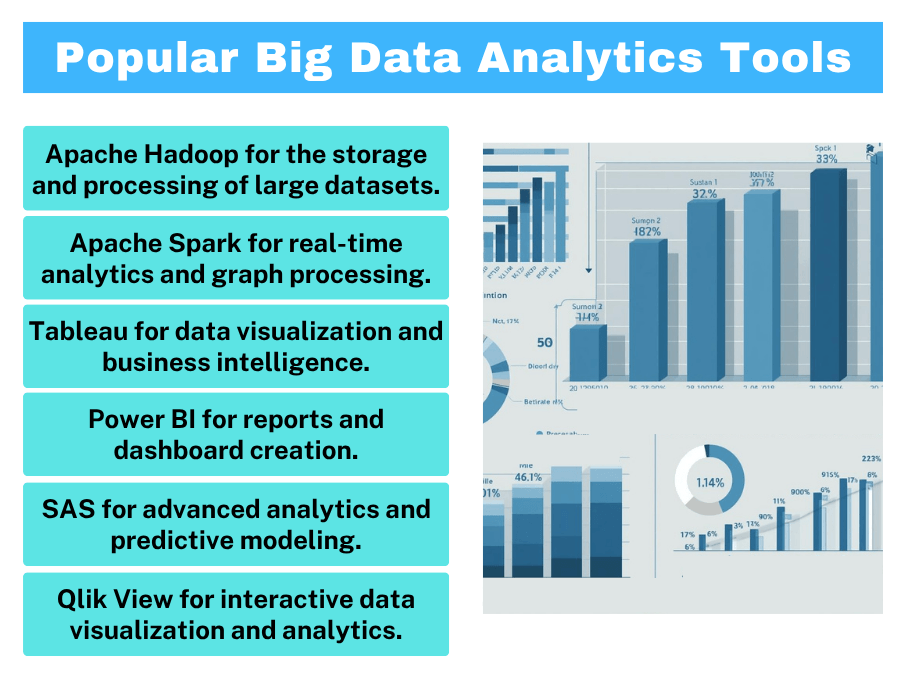
Which Methods are Most Appropriate for Big Data Analytics?
Using suitable methods for big data analytics is crucial, considering that traditional processing techniques are incapable of handling the large volume, velocity, and variety of modern data. Big data analytics methods include;
- Predictive analytics: Predictive analysis in big data is an approach that uses machine learning, historical data, and statistical algorithms to identify patterns and predict future events for a business.
- Machine learning (ML): Machine learning in big data analytics is an artificial intelligence subset that applies algorithms to detect trends and relationships within complex and large datasets.
- Real-time analytics: Real-time analytics is a big data technique used to examine data as it is generated, ingested, or streamed, to enable insights within seconds or milliseconds.
- Regression analysis: Regression analysis is a statistical method used in big data analytics to quantify, identify, and model the relationships between a dependent and one or more independent variables.
- Prescriptive analytics: Prescriptive analytics is an advanced big data technique that uses AI, optimization algorithms, and machine learning to suggest specific actions for optimum business results.
Summary
For large-scale businesses, analytics tools for big data have become imperative due to the massive volume of information they require to manage regularly. These tools are crucial in helping industries save resources, obtain valuable insights, and make informed decisions. Considering that big data analytics is the process of capturing, organizing, and examining huge datasets, high-performance processing capabilities are a requirement. To examine such massive volumes of data, specialized software such as big data analytics tools is a necessity. In case you are looking for experts in big data analytics, reach out to our professionals today via our live chat or by contacting us. Our customer support team is available 24/7 to respond to your inquiries promptly.