
Hire an Expert to Do Programming in R
A common software application used for programming is R, which provides advanced capabilities for statistical computing and developing graphical presentations. However, R has a steep learning curve due to its unfamiliar syntax and complex data structures, and users must learn commands and coding in detail to achieve the best results. In case you are an individual or business looking for help with conducting statistical analysis with the software suite, you can hire an expert to do programming in R from our firm for the best services, customized to your unique needs.
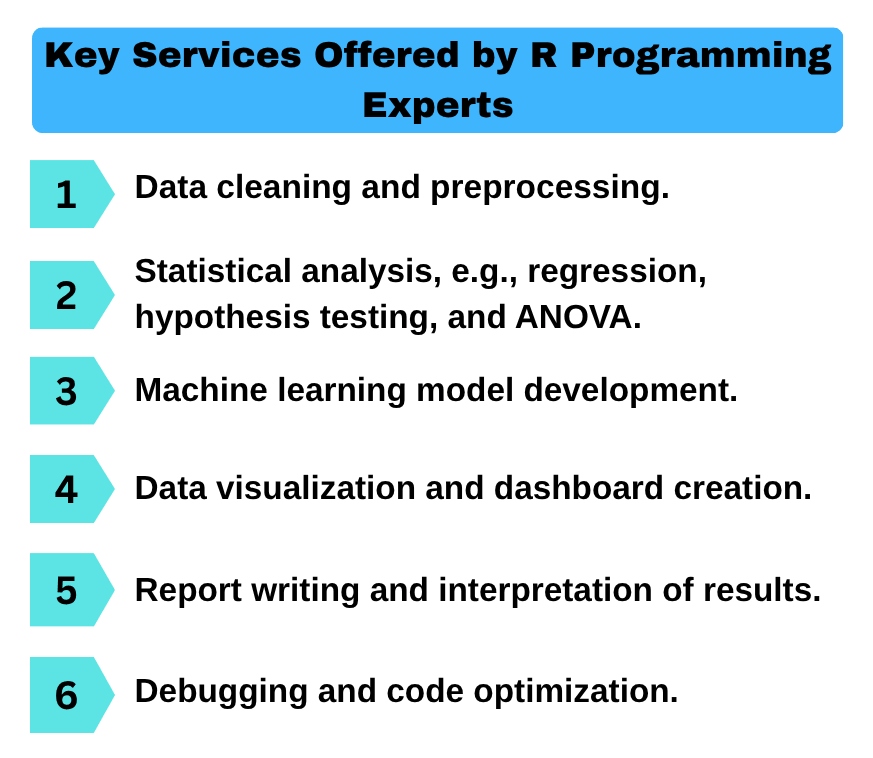
Our experts offer comprehensive services using R, such as statistical analysis and data visualization, among others, to help clients transform their raw data sets into useful insights, enabling them to understand their data and optimize their operations. This article contains an outline of how clients can evaluate and select the right R experts, based on their research objectives. This post also highlights the fundamental concepts of R programming, such as variables, data types, and writing functions.
Understanding the R Programming Language
The R programming language is an integrated suite of tools for data manipulation, calculation, and graphical display. Ross Ihaka and Robert Gentleman created R at the University of Auckland, New Zealand, and it is currently under constant refinement by the R Development Core Team. With R, users can perform a wide variety of procedures, including statistical computing, modeling, analysis, and visualization. Reasons why our experts employ the R programming language for statistical operations include:
- R is superior to other programming languages in terms of the variety of options available, programmability, and graphics, among others.
- R is available for the Windows, Mac, and Linux operating systems, enabling easy collaboration.
- In addition to statistical operations, R is a general-purpose programming language, so we use it to automate analyses and develop new functions that extend the existing language features.
- Most new functions in R are contributed by users, mainly comprising professional statisticians.
- Has a suite of operators for calculations on arrays, lists, vectors, and matrices.
- R has graphical facilities for data analysis and display either directly at the computer or on hard copy.
Basic Concepts of R Programming
The R programming language can be challenging to learn, especially if users are new to data science, because of its unfamiliar syntax. However, once users understand the basic concepts, R becomes a powerful software application for data cleaning, analysis, and visualization. Some of the fundamental concepts of R programming that statisticians should be familiar with include:
1. Variables
When programming in any language, users need to utilize variables to store information. A variable serves as a memory location that is used to keep values and provides a named storage that programs can manipulate. Users may store information of various data types, such as character, wide character, integer, floating point, or Boolean. Based on the data type of a variable, the operating system allocates memory and decides what can be stored in the reserved memory. A valid variable in the R coding language comprises letters, numbers, dots, or underline characters, but cannot start with a number or an underscore.
2. Data Types
Data types are classifications in programming languages that specify the way a variable will be stored in memory and the type of data it holds. Data types in R are used to demonstrate the information that is stored in a variable and determine how it behaves during calculation and analysis. By defining the structure of data, R users can ensure consistency in how data is used and manipulated across different parts of the programming language. R has five basic types of data, which are:
i). Numeric that represents real numbers.
ii). Integer that contains whole numbers that do not have a fractional or decimal part.
iii). Logical, used to represent binary or Boolean values.
iv). Complex numbers are an extension of real numbers that introduce the concept of an imaginary unit, denoted by i or j.
v). Strings that are used to represent sequences of characters such as letters, numbers, symbols, and spaces.
3. Data Structures
A data structure is a way of organizing and storing data in a computer. Data structures allow users and systems to efficiently organize, work with, and store data. R’s basic data structures include vectors, lists, arrays, and data frames. A vector is the most basic data structure in R that contains elements that have the same data type. Lists are objects in R that contain different types of objects within themselves, such as numbers, strings, vectors, or even another list. An array is a data object in R that can store multidimensional data of the same data type. A data frame refers to a two-dimensional array-like structure or table in which each column can contain different types of data, and each row has one set of values from each column.
4. Writing Functions
One of the main features that makes R flexible is the programming language’s ability to create functions. Writing functions in R allows users to summarize a set of instructions into a reusable and modular block of code, promoting code organization and efficiency. Functions in R provide the backbone for modular, efficient, and structured code.
5. Control Structures
Control structures in R allow users to control the flow of execution of a series of R expressions. With control structures, users are able to respond to inputs or features of the data and execute different R expressions accordingly. Commonly utilized control structures in R include:
i). if and else used for testing a condition and acting on it.
ii). for used to execute a loop a specific number of times.
iii). while for executing a loop while a condition is true.
iv). repeat for executing an infinite loop.
v). break for breaking the execution of a loop.
vi). next for skipping an interaction of a loop.
How to Evaluate and Choose the Right R Expert
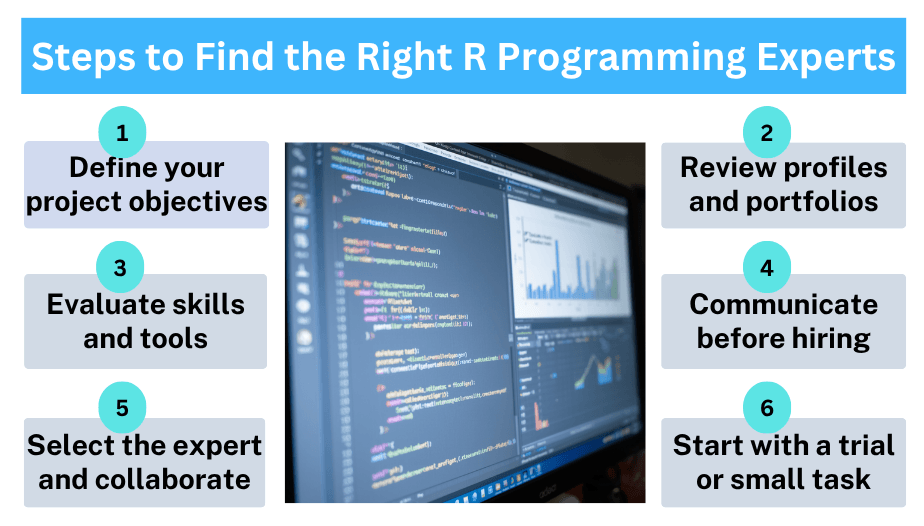
Selecting the right R expert involves evaluating their skills and potential ability to deliver accurate results that align with research objectives. Some of the factors individuals and businesses should consider when hiring an expert to do programming in R include:
- Technical competency in R.
- Subject matter expertise relevant to a specific field of study.
- Experience in doing similar work in programming in R.
- Positive customer reviews.
- People and communication skills.
- Data privacy.
Reasons to Hire an Expert to do Programming in R From Our Company
The main reasons why we stand out as the best service providers in R programming include:
- Team of professional R programmers. Our subject-matter experts are highly vetted to be skilled in handling, manipulating, modeling, and developing graphical presentations in R for clients to deliver meaningful results.
- Customized services based on client goals. We specialize in offering excellent services, tailored to clients’ research goals. Some of the solutions clients can get from our experts include data manipulation, statistical analysis, machine learning, visualization, and composing reports.
- Excellent customer service. Our dedicated consultants are readily available to respond to client inquiries, provide regular order updates, and handle revision requests from clients. We offer the best support from initial inquiry to final order submission, ensuring maximum client satisfaction with our services.
- 24/7 availability. We are available around-the-clock, enabling clients to reach out to us at any time, regardless of their geographical locations. Our 24/7 availability also enables us to handle urgent client orders and deliver quality results on time.
- On-time delivery without compromising on quality. Every order we handle is completed within the agreed timeline while maintaining the highest standards of accuracy and professionalism.
Summary
R is a programming language that provides users with a wide range of features for conducting statistical computing and graphics. Some of the basic functions of the R programming language include variables, data types, data and code structures, and writing functions, among others. The basic functions in R simplify coding by summarizing complex operations into reusable blocks, which improve code organization. R is one of the best programming languages for conducting statistical analysis and data visualization, making the software suitable for application in various fields of research. In case you need to hire an expert to do programming in R, look no further than our experts. Book a consultation with our experts today by contacting us or joining our live chat to talk to our customer service agents.