
Leveraging SAS For Longitudinal Data Analysis in Doctoral Studies
Longitudinal data analysis encompasses various statistical techniques used to examine data collected over extended periods, enabling scholars to understand temporal effects and dynamic relationships within complex systems. The methodologies in longitudinal data analysis, which include variable-centered, person-centered, and person-specific models, allow scholars to characterize the factors that influence change. By tracking change and continuity, PhD scholars can utilize longitudinal data analysis to understand phenomena, ranging from individual behavior to clinical outcomes.
Scholars conducting longitudinal data analysis can employ a variety of software packages to perform their analyses. The software program selected depends on factors such as the PhD students’ skills, experience, and the complexity of the data. Statistical software such as SAS and R have advanced features to handle the complexities in longitudinal data, including modeling and visualization, among others. This article focuses on longitudinal data analysis in SAS, highlighting the step-by-step procedure followed by our experts. In this blog, we have also discussed common SAS procedures used for longitudinal data analysis.
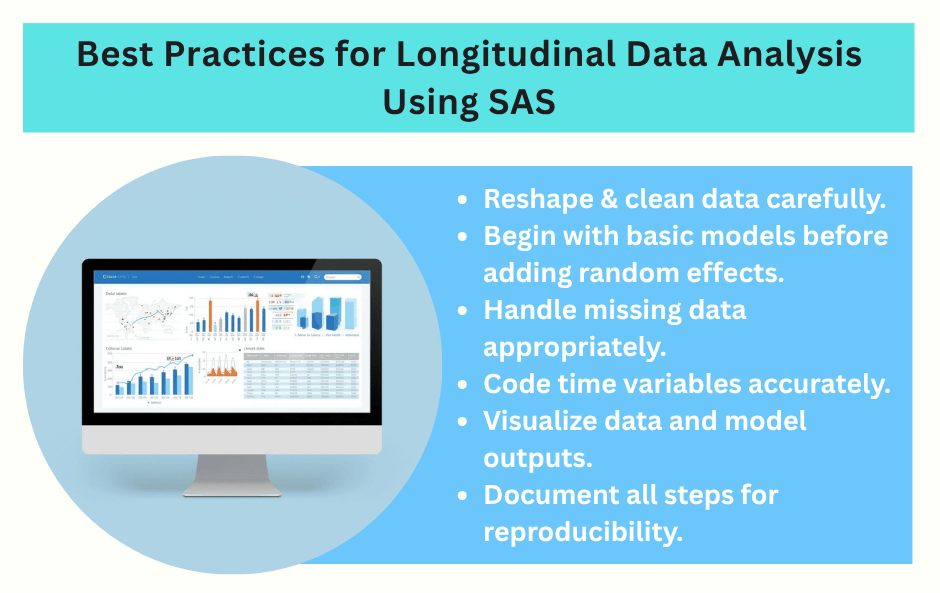
What is Longitudinal Data Analysis in SAS?
Longitudinal data analysis in SAS is the application of the software program to examine data collected from the same subjects over multiple time points, thus enabling the study of change and development. Features in SAS that make the software program suitable for conducting longitudinal data analysis in doctoral studies include:
- Intuitive fourth-generation programming language (4GL) with easy-to-learn syntax. The intuitive 4GL syntax in SAS allows scholars to focus on the data structure and relationships between variables instead of programming.
- Supports a wide range of data formats. SAS enables scholars to read data in any format, from different files, such as variable-length records, binary files, and free-formatted data.
- Powerful longitudinal data analysis capabilities. SAS offers various procedures for analyzing correlated repeated measurements data, including PROC GEE, PROC GLIMMIX, PROC MIXED, and PROC GENMOD.
- Advanced data manipulation capabilities. Scholars can manage and manipulate longitudinal data using features such as the CALL SYMPUT routine and RETAIN statements.
- Reporting and visualization. After conducting longitudinal data analysis in SAS, scholars can create reports in standard formats such as RTF, PDF, and Microsoft PowerPoint. Additionally, PhD students can create visually appealing graphics from analytic output without additional programming.
Need an expert for help with longitudinal data analysis in SAS? We specialize in offering the best solutions to PhD students to characterize changes in responses over time. Get in touch with our expert statisticians and enjoy excellent customer support, prompt responses to inquiries, and accurate results that elevate your doctoral research.
Key SAS Procedures for Longitudinal Data Analysis
The SAS procedures our experts employ to conduct longitudinal data analysis include:
1. PROC MIXED
The SAS PROC MIXED is a powerful procedure that is used to efficiently analyze longitudinal data, especially when missing data is prevalent. The PROC MIXED procedure was specifically designed to fit mixed-effect models. Mixed-effects models allow for different sources of variation in data, account for distinct variances across groups, and take into account the correlation structure of repeated measurements. The SAS PROC MIXED procedure is essential for longitudinal data analysis due to its ability to handle repeated measures and missing data.
2. PROC GLIMMIX
SAS PROC GLIMMIX is a procedure that is used to conduct longitudinal data analysis, where it fits statistical models to data with correlations or non-constant variability and where the response is not necessarily normally distributed. The statistical models utilized in PROC GLIMMIX are referred to as generalized linear mixed models (GLMM). GLMMs usually assume normal random effects. The PROC GLIMMIX procedure in SAS is essential for longitudinal data analysis because it fits GLMMs, allowing for the analysis of non-normal data with both fixed and random effects.
3. PROC GEE
The GEE procedure implements the generalized estimating equations (GEE) approach, which extends the generalized linear model to handle longitudinal data. For longitudinal studies, missing data is common, and it can be caused by dropouts or skipped visits by participants. If missing entries depend on previous responses, the usual GEE procedure can lead to biased estimates. So, the GEE procedure also implements the weighted GEE method to handle missing responses in longitudinal studies. The PROC GEE method fits marginal models to longitudinal data. The GEE procedure is appropriate for complete data or when data is missing completely at random.
4. PROC PANEL
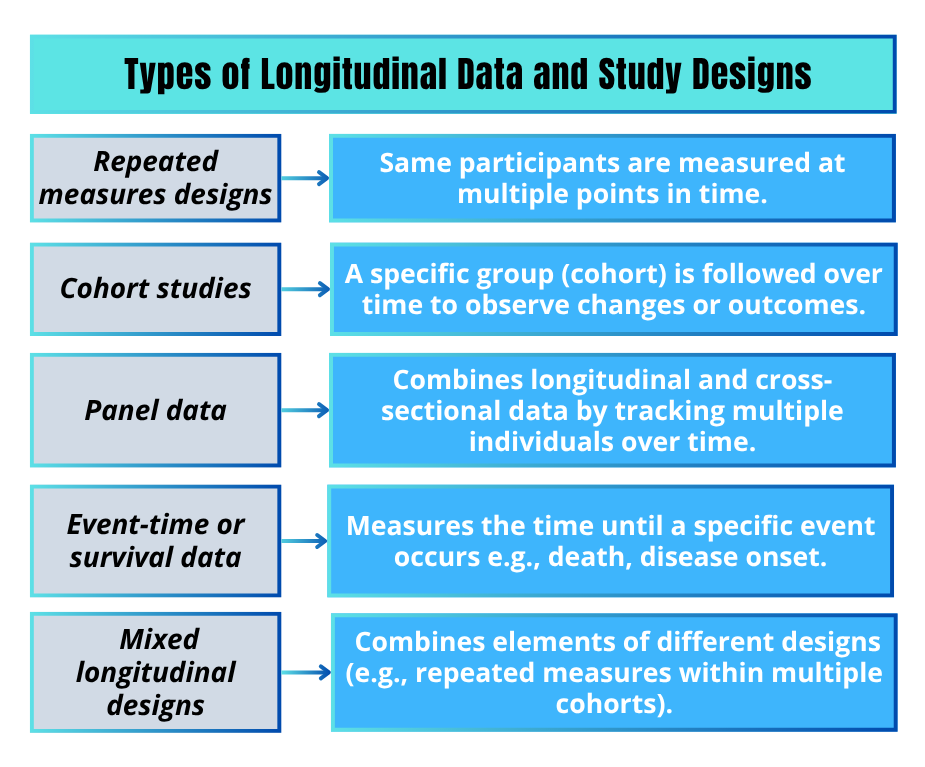
Panel data research is a technique that involves collecting data from the same subjects repeatedly over a period of time. One of the procedures in SAS used for panel data research is the PROC PANEL, which is used to analyze a class of linear econometric models that develop when time series and cross-sectional data are integrated. The pooled data on time series cross-sectional bases is usually referred to as panel data. The PROC PANEL procedure uses various error structures and corresponding methods to analyze longitudinal data, which include (i) one-way and two-way, (ii) fixed-effects and random-effects, (iii) autoregressive, and (iv) moving average models.
Why Hire Us for Help with Conducting Longitudinal Data Analysis in SAS?
Institutions expect scholars working with repeated measures to demonstrate a clear understanding of longitudinal methodology and correct model selection. Flawed longitudinal data analysis results are common reasons for thesis revisions and research methodology criticism. At our company, we offer expert academic support for longitudinal data analysis in doctoral studies. Key reasons why PhD scholars choose us for assistance with conducting longitudinal data analysis in SAS include:
- Team of expert statisticians. We have a team of professionals with expert-level proficiency in conducting longitudinal data analysis with SAS. From data preparation to analysis reporting, our experts apply their skills to deliver the best results, tailored to the clients’ study objectives.
- 10+ years of experience offering longitudinal data analysis services. Our experts have over a decade of experience in conducting longitudinal data analysis with SAS, so we are familiar with a wide range of complex studies, including repeated measures, cohorts, and panel research designs.
- Punctual delivery without compromising on quality. Our dedicated statisticians are committed to analyzing longitudinal data with SAS within the clients’ desired timeframe and delivering accurate results.
- Round-the-clock availability. Our consultants are available 24/7, allowing clients to contact us at any time, regardless of their geographical location. Our round-the-clock availability enables scholars to reach out to us anytime for inquiries, order updates, or revision requests.
- Customized longitudinal data analysis services. Our professional statisticians offer the best longitudinal data analysis solutions in SAS, tailored to specific client objectives. Whether clients need help with repeated measures analysis, panel, or cohort studies, we have the skills required to deliver excellent results.
Summary
Longitudinal analysis has a significant impact on doctoral research, enabling scholars to understand the growth, change, or decline in individuals and to characterize the factors that influence change. An essential feature of longitudinal analysis in PhD research is taking repeated measures of an outcome on the same set of individuals at multiple time points, thus allowing scholars to characterize subject changes within the measurement period. Scholars conducting longitudinal analysis for their doctoral studies can employ statistical software such as SAS or R to examine data they have collected from the same subjects over multiple time points.
Core features that make SAS suitable for longitudinal data analysis in PhD research include a 4GL intuitive interface, data manipulation capabilities, and the ability to support a wide range of data formats, among others. In case you are searching for expert help with conducting longitudinal data analysis in SAS, we are the solution you are looking for. Elevate your doctoral study by hiring our expert statistician today. Contact us now to get started.